
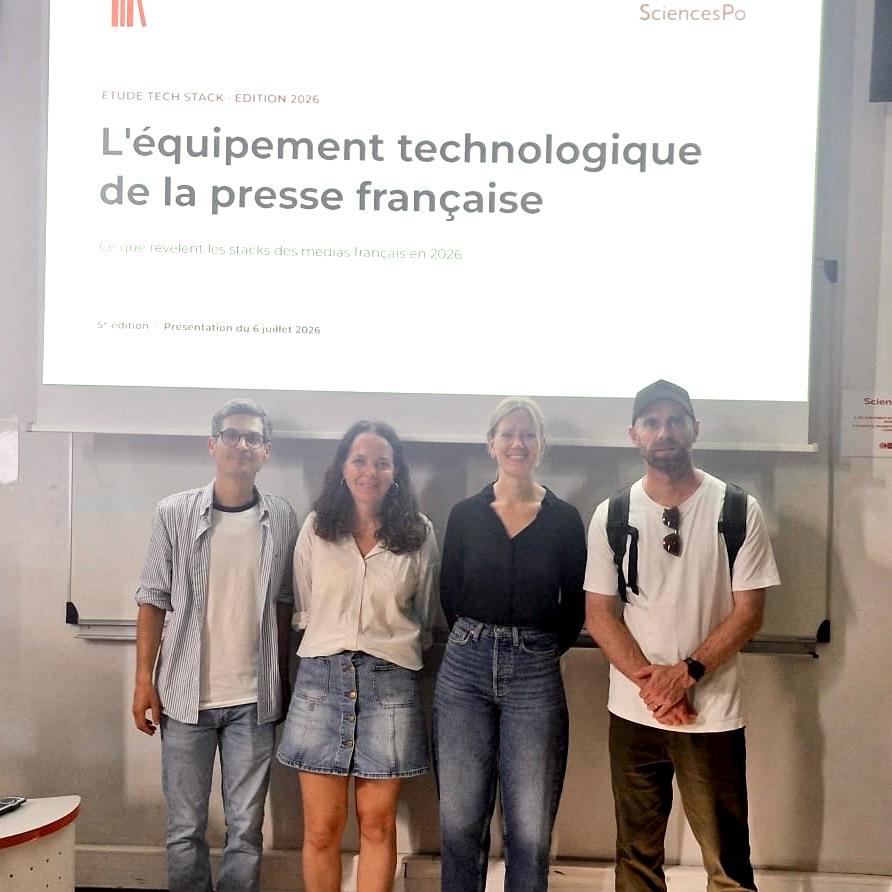
For its fifth edition, the “Tech Stack” study — conducted by the association of the same name in partnership with the Sciences Po Journalism School — paints the most complete picture to date of the tools that French news publishers rely on to produce, distribute and monetise the news. Four tool families, 118 contributions, nearly 5.5 billion monthly page views described: the findings of the 2026 edition are now available to download.
Which tools do French news publishers actually use to produce, distribute and monetise their digital content? Since 2021, the “Tech Stack” survey has answered this question by drawing directly on the voices of the professionals who work with these tools day to day: chief technology officers, newsroom managers, product managers, marketing managers and ad sales house directors. Between in-house solutions and external vendors, they all administer a technical apparatus in constant recomposition. The very word “stack” captures the iterative nature of this accumulation, driven by the evolution of technologies and the transformation of usages.
Launched in 2021 on the initiative of Marion Wyss, an online-media professional and specialist in subscriber-acquisition strategies, the Tech Stack reaches its fifth edition in 2026. As early as 2022, Sciences Po joined the project to ensure its longevity in the form of an annual update. Its founding principle remains unchanged: to consolidate the full range of practices in order to draw up a complete overview, while guaranteeing each respondent strict confidentiality over the solutions they report using.
A survey of unprecedented scope
The 2026 edition is based on four separate questionnaires — marketing, editorial, advertising and technical tools — completed by the managers of the relevant teams. Each solution cited was analysed through a twofold approach: its market share among respondents on the one hand, and an assessment of its quality on the other. Beyond listing the tools they use, respondents rate them: each professional gives their solution a satisfaction score from 1 to 10 and specifies, in free-text comments, what wins them over or frustrates them in terms of quality and everyday use. It is the aggregation of these scores that makes it possible to measure whether, in France, publishers feel well served by their CMS, their subscription manager or their adserver. And it is this cross-analysis of equipment rate and satisfaction that makes the study a genuine decision-support tool, allowing each publisher to guide its own equipment choices by drawing on the experience of its peers.
Measured against the combined audience of all participating titles, the study describes the Tech Stack underpinning more than five billion monthly page views. Contributors include the majority of national daily press titles, several audiovisual brands, magazine titles, regional and trade press groups, as well as numerous pure players. In keeping with the confidentiality commitment made to respondents, all responses were consolidated and processed anonymously, but the list of respondents is set out in the study’s introduction and in each section.
Publishers now properly equipped
The first takeaway from the 2026 edition lies in the convergence of scores. The four tool families obtain closely aligned averages: 7.1/10 for marketing, 7.2 for editorial, and 7.4 for both advertising and technical tools. The message is clear: French publishers are now properly equipped. No category collapses, and none reaches excellence. The gaps lie at the extremes, from the success of digital advertising audio to the struggles of the subscription manager — the backbone of the subscriber relationship, still largely inherited from the print era. Over three years, the trend is one of slow improvement as stacks stabilise.
This maturity shifts the challenge. Everywhere, value no longer lies in the tool itself but in its ability to connect to others. Marketing calls for a unified data layer; editorial dreams of a CMS turned cockpit, linking planning, publishing, social media and measurement; the technical side seeks observability and orchestration; and advertising, the reconciliation of its fragmented signals. The 2026 stack is not under-equipped: it is under-orchestrated. To this integration tension is added, among legacy press groups, a persistent divide between print-inherited foundations and digital building blocks — a divide that dreaded migrations still struggle to close.
Two underlying forces: AI and sovereignty
Two dynamics run through all the chapters. First, artificial intelligence, now present in almost every use case (nearly nine publishers out of ten on the marketing side) but still confined to assistance and individual productivity. Its industrialisation, plugged into data, is shaping up to be the next front of differentiation. Second, sovereignty, which is emerging as a structuring criterion in the face of dependence on the major US players — from web analytics to the adserver, from cloud to language models — and in the face of rising costs (licences, cloud, tokens) that everyone is seeking to keep under control.
One constant remains, a common thread throughout the study: in-house solutions, when designed together with the teams, consistently earn the best scores. Proof that satisfaction stems less from a tool’s power than from its right fit with needs. That is where the 2027 challenge lies: not in accumulating new building blocks, but in the art of connecting them.
Download the study
The full results — a detailed analysis of the four tool families, equipment rates, satisfaction scores and publisher verbatims — are available in the complete summary of the “Tech Stack 2026” survey.
→ Download the Tech Stack 2026 study (PDF)
A study by the Tech Stack association, in partnership with the Sciences Po Journalism School.